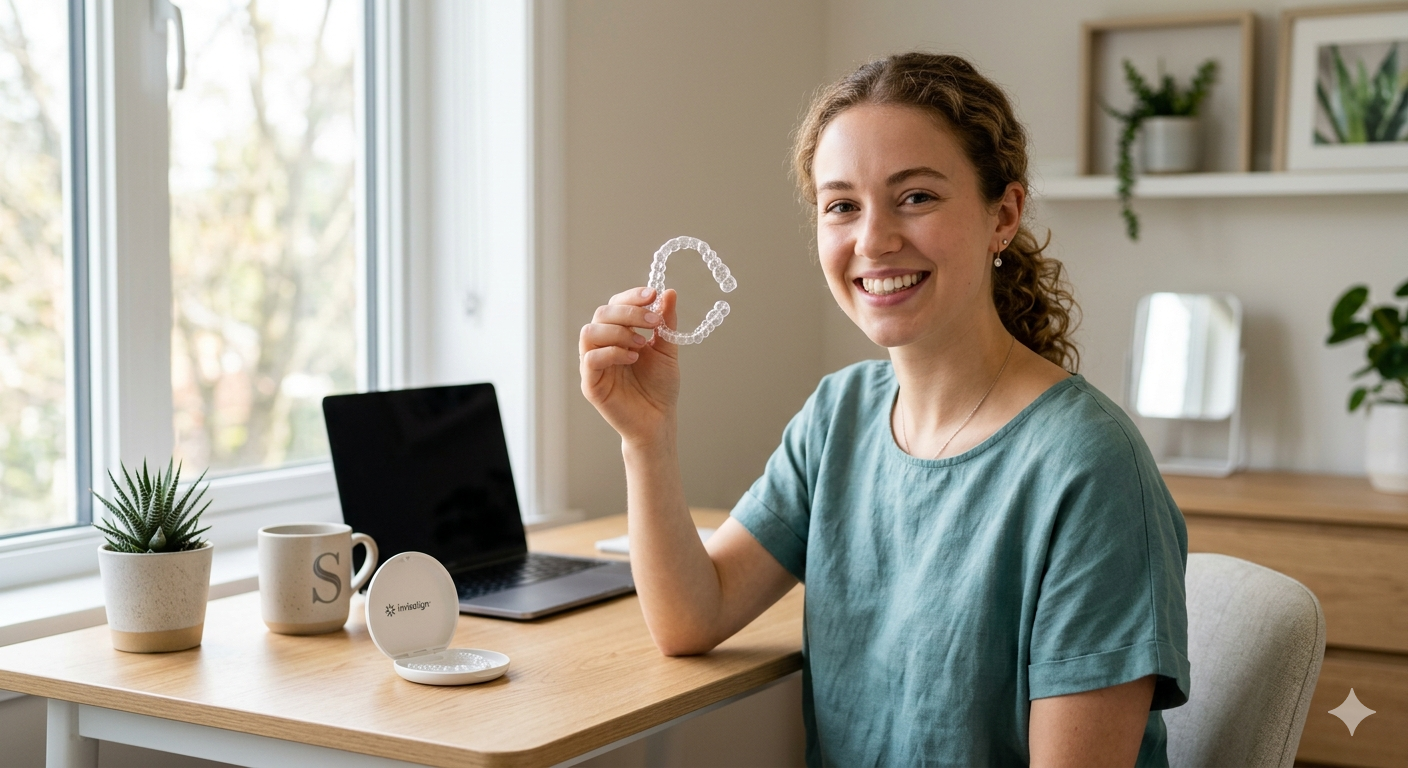
What are Invisalign aligners? Invisalign aligners are clear, custom-made trays worn over the teeth to gradually move them into a planned position. They are an alternative to traditional braces and are designed to be discreet, removable and more convenient for eating, brushing and flossing. Each aligner applies gentle pressure to guide the teeth step by step.
At Oakstone Dental, we help patients understand whether Invisalign is suitable for their smile, bite and lifestyle before treatment begins. If you have been wondering what Invisalign treatment is, how Invisalign works, or whether clear aligners vs braces in Australia is the right comparison for you, this guide will walk you through the essentials in plain language.
Quick answers about Invisalign aligners
| Question | Short answer |
| What are Invisalign aligners? | They are clear, removable trays that fit over your teeth and gradually move them into a planned position. |
| Is Invisalign the same as braces? | No. Invisalign uses removable clear aligners, while braces use fixed brackets and wires. |
| How does Invisalign work? | You wear a series of aligners, with each set moving your teeth slightly closer to the planned result. |
| Can everyone get Invisalign? | No. Invisalign suits many patients, but some cases still need braces or specialist orthodontic care. |
| Do I need a consultation first? | Yes. A dental assessment is needed to check your teeth, gums, bite and suitability. |
What is Invisalign treatment?
Invisalign treatment is a clear aligner system used to straighten teeth and improve certain bite concerns. Instead of using metal brackets and wires, Invisalign uses a series of thin, clear aligners that fit over your teeth.
Each aligner is slightly different. As you move through the sets, your teeth are guided gradually into a planned position.
At Oakstone Dental, we assess your suitability for Invisalign before confirming whether it is right for you. If Invisalign is suitable, we arrange and refer you to Chadstone Orthodontics, who have partnered with us and looked after our patients having Invisalign treatment.
Invisalign may be used to help with:
- Mild crowding
- Mild spacing
- Relapse after previous orthodontic treatment
- Some bite concerns
- Cosmetic alignment concerns
- Teeth that have shifted over time
- Some cases where patients want a more discreet option than braces
It is not suitable for every case, which is why the consultation is important.
Invisalign clear aligners explained
Invisalign aligners are custom-made, clear plastic trays. They are designed to fit snugly over your teeth and apply controlled force to move selected teeth.
They are:
- Clear
- Thin
- Removable
- Custom-made
- Worn over the teeth
- Changed regularly through treatment
- Designed from a planned tooth movement sequence
On our Invisalign page, we explain that Invisalign uses clear thin plates called aligners, which are worn over the teeth and are designed to be comfortable and nearly invisible. A new set of upper and lower aligners is given each fortnight to provide the force needed to move the teeth.
The Australian Dental Association explains that clear aligners are custom-made thin plastic trays worn over the teeth to straighten them. They should be worn at all times other than when eating and drinking liquids other than water, and your dentist or orthodontist can advise whether they are suitable for your situation. Their guide to teeth straightening and braces also explains that clear aligners are one option alongside traditional braces.
How does Invisalign work?
Invisalign works by applying gentle, planned pressure to your teeth through a series of aligners. Each aligner moves certain teeth a small amount. When worn in the correct order, the aligners guide the teeth towards the planned position.
Step 1: We check your suitability
The first step is a consultation. We look at your teeth, bite, gums, oral health and goals. Invisalign is suitable for many patients, but not everyone.
We may check:
- Tooth crowding
- Spacing
- Bite position
- Gum health
- Tooth wear
- Existing fillings, crowns or veneers
- Jaw comfort
- Oral hygiene
- Previous orthodontic treatment
- Whether Invisalign or braces may be more suitable
Our Invisalign page explains that Invisalign works for many patients but is not suitable for all, and that some cases may still require traditional braces. We invite patients to book a consultation with Dr Emily Ling so we can assess whether Invisalign is the right choice for their smile.
Step 2: Records and planning
If Invisalign is suitable, records are taken to plan treatment. This may include scans, photos, x-rays or other assessments.
The goal is to understand:
- Where your teeth are now
- Where they need to move
- How much movement is required
- Whether your bite needs correction
- Whether attachments are needed
- How many aligners may be required
- How long treatment may take
Healthdirect Australia explains that orthodontic treatment may involve x-rays and plaster or digital models of the teeth, followed by a treatment plan. Their guide to orthodontic treatments also notes that treatment often uses braces or aligners to straighten crooked teeth or correct bite problems.
Step 3: Your aligners are made
Your aligners are made to fit your teeth and treatment plan. Each aligner is part of the full sequence.
You do not get one aligner that does all the work. You receive a series. Each one helps move your teeth gradually.
Step 4: You wear your aligners each day
Your aligners need to be worn as instructed. Because they are removable, patient habits matter.
You usually remove them for:
- Eating
- Drinking anything other than water
- Brushing
- Flossing
- Cleaning the aligners
You then place them back in so the teeth can keep moving as planned.
Step 5: You change aligners as directed
At Oakstone Dental, patients receive a new set of upper and lower aligners each fortnight during treatment. You also come in to see Dr Ling every six weeks for a short appointment to receive your next set of aligners and keep treatment on track.
Step 6: We review your progress
Progress reviews help us check that your teeth are tracking correctly. If an aligner is not fitting well, or a tooth is not moving as expected, we want to know early.
Step 7: Retainers help maintain the result
After Invisalign, retainers are usually needed to help keep your teeth in their new position. Teeth can shift back over time if retainers are not worn as advised.
Healthdirect notes that retainers may be needed after orthodontic treatment because teeth tend to move back towards their original position over time.
Are Invisalign aligners actually invisible?
No clear aligner is completely invisible. However, Invisalign aligners are designed to be discreet.
Most people find they are much less noticeable than metal braces. Oakstone Dental’s Invisalign page explains that Invisalign aligners are transparent and difficult to detect when worn, allowing patients to transform their smile with minimal disruption to daily life or appearance.
Some people may still notice:
- Small tooth-coloured attachments
- A slight shine over the teeth
- Minor speech changes at first
- Aligners when viewed very closely
Most patients adjust quickly.
Clear aligners vs braces Australia: what is the difference?
Invisalign and braces can both move teeth, but they work differently.
| Feature | Invisalign clear aligners | Traditional braces |
| Appearance | Clear and discreet | More visible |
| Removable | Yes | No |
| Eating | Removed before eating | Food restrictions may apply |
| Brushing and flossing | Easier because aligners are removed | More care needed around brackets and wires |
| Treatment control | Depends heavily on patient wear time | Fixed to teeth, so always working |
| Suitability | Best for selected mild to moderate cases and some complex cases | Often better for more complex tooth movement |
| Comfort | Smooth trays, usually less irritation | Brackets and wires can rub at times |
| Appointments | Regular reviews still needed | Regular adjustments needed |
| Compliance | Requires discipline | Less dependent on remembering to wear appliances |
The Australian Dental Association explains that traditional braces are still commonly used, while clear aligners provide an alternate option for straightening teeth. It also notes that clear aligners are not invisible and suitability should be assessed by a dentist or orthodontist.
The right choice is not simply about which looks better. It depends on your teeth, bite, oral health, goals, lifestyle and how reliably you can wear aligners.
Who is Invisalign suitable for?
Invisalign may suit patients who want a more discreet way to straighten their teeth and who can commit to wearing aligners properly.
It may be suitable for:
- Mild crowding
- Mild spacing
- Some rotated teeth
- Some bite concerns
- Teeth that have shifted after previous orthodontic treatment
- Adults who want a removable option
- Teens or adults who can follow instructions
- Patients with good oral hygiene
It may not be suitable for:
- Severe bite problems
- Complex jaw concerns
- Severe crowding
- Poor gum health
- Active tooth decay
- Patients who will not wear aligners consistently
- Some cases involving missing teeth or complex restorations
At Oakstone Dental, we do not want patients to start treatment unless it is suitable. We prefer to assess properly first, then explain your options clearly.
What are the benefits of Invisalign aligners?
Many patients like Invisalign because it fits more easily into daily life than traditional braces.
1. They are discreet
Clear aligners are less noticeable than metal braces. This can be helpful for adults, professionals, students or anyone who feels self-conscious about orthodontic treatment.
2. They are removable
You can take them out to eat, brush and floss. This makes meals and oral hygiene simpler.
3. There are fewer food restrictions
Because aligners are removed while eating, you do not need to avoid foods because of brackets or wires. You still need to brush before putting aligners back in, especially after sugary or sticky foods.
4. Oral hygiene is easier
Brushing and flossing can be easier than with braces because there are no fixed brackets on the teeth. However, aligners also require discipline. You need to keep both your teeth and aligners clean.
5. They can suit busy lifestyles
Invisalign can be convenient for patients who want a straighter smile with minimal disruption. At Oakstone Dental, we also offer online booking and a familiar, gentle practice environment for patients in Oakleigh and nearby suburbs.
What are the limitations of Invisalign?
Invisalign is helpful, but it is not a perfect fit for everyone.
Limitations may include:
- It must be worn consistently
- It may not suit complex cases
- Attachments may be needed
- Aligners can be lost or damaged
- You need to remove them before eating
- You must clean your teeth before reinserting them
- Some cases may require refinements
- Speech may feel different at first
- Treatment results vary between patients
The Australian Dental Association also cautions against DIY or direct-to-consumer orthodontic treatment, noting that in-person treatment with proper assessment and ongoing supervision is recommended.
That is one reason we believe supervision matters. Orthodontic treatment is not just cosmetic. It involves your teeth, gums, bite, jaw joints and long-term function.
What does Invisalign feel like?
Invisalign aligners should feel snug. When you start a new set, you may feel pressure or tightness for a few days. This is normal because the aligners are applying force to move the teeth.
You may notice:
- Pressure when inserting a new aligner
- Mild tenderness when biting
- Slight speech changes at first
- Saliva changes in the first few days
- Awareness of the aligners in your mouth
- Mild rubbing until you adjust
If you feel sharp pain, severe discomfort, gum trauma or an aligner does not fit properly, contact us so we can check it.
What can you eat with Invisalign?
You remove Invisalign aligners before eating. This means you can generally eat your normal foods, unlike braces where sticky or hard foods may cause problems.
However, there are still important habits to follow:
- Remove aligners before meals
- Drink water while aligners are in
- Avoid drinking sugary or acidic drinks with aligners in
- Brush before reinserting aligners where possible
- Rinse your mouth if brushing is not possible straight away
- Clean aligners daily
- Store aligners in their case when not wearing them
Leaving aligners in while eating can damage or stain them. It can also trap food and sugar against the teeth.
How long do you wear Invisalign each day?
Most Invisalign patients are advised to wear aligners for most of the day and night, removing them only for eating, drinking anything other than water, brushing and flossing.
Your exact instructions may vary, but the principle is simple: aligners only work when they are worn.
If aligners are left out too long, your teeth may not move as planned. This can affect the fit of the next aligner and may delay treatment.
How long does Invisalign treatment take?
Invisalign treatment time varies. Some minor cases may take several months. More involved treatment may take 12 to 18 months or longer.
Factors that affect timing include:
- How much tooth movement is needed
- Whether the bite needs correction
- How consistently aligners are worn
- Whether teeth track as expected
- Whether refinement aligners are needed
- Oral health during treatment
- Appointment attendance
Healthdirect notes that orthodontic treatment usually takes about 1 to 3 years overall, depending on the type and complexity of care. Clear aligner treatment may be shorter or longer depending on the case.
At your consultation, we can give you a more realistic idea based on your teeth.
What are Invisalign attachments?
Attachments are small tooth-coloured shapes bonded to certain teeth during treatment. They help the aligners grip and move teeth more predictably.
Not everyone needs the same number of attachments. Some patients need only a few. Others need more.
Attachments may help with:
- Rotating teeth
- Moving teeth vertically
- Improving grip
- Guiding more complex movements
- Helping aligners seat properly
They are usually removed at the end of treatment.
Will Invisalign affect speech?
Some patients notice a slight lisp when they first start wearing aligners. This usually improves as the tongue adapts.
To adjust faster, try:
- Speaking slowly at first
- Reading out loud for a few minutes
- Wearing aligners consistently
- Giving yourself a few days to adapt
Most patients find speech changes settle quickly.
How do I clean Invisalign aligners?
Clean aligners help keep your mouth fresh and reduce staining.
Simple care steps include:
- Rinse aligners when you remove them
- Brush them gently with a soft toothbrush
- Avoid hot water, which can warp the plastic
- Store them in their case
- Brush and floss before reinserting them
- Avoid coloured drinks while wearing them
- Do not wrap them in tissues, as they may be thrown away
Good aligner care also helps protect your teeth during treatment.
What happens if I lose an aligner?
If you lose an aligner, contact us or your treating orthodontic provider for advice. Do not simply skip ahead unless instructed.
Depending on your stage of treatment, you may be advised to:
- Wear your previous aligner temporarily
- Move to the next aligner if appropriate
- Order a replacement
- Attend a review
Guessing can affect tooth movement, so it is better to ask early.
What happens if Invisalign is not right for me?
If Invisalign is not the best choice, we will explain why. Some cases may be better suited to braces or specialist orthodontic care.
This is not bad news. It simply means we want you to choose the treatment that gives you the safest and most predictable result.
At Oakstone Dental, our approach is based on honest advice. Our home page explains that we clearly explain options and pricing, and only recommend treatment that is right for the patient.
What does Invisalign cost in Australia?
Invisalign cost in Australia varies depending on case complexity, treatment length, number of aligners, refinements, retainers and provider fees.
Cost may depend on:
- Mild, moderate or complex treatment
- Number of aligners required
- Whether attachments are needed
- Whether refinements are needed
- Review appointments
- Records, scans or x-rays
- Retainers after treatment
- Private health fund extras cover
Healthdirect recommends asking your dentist or orthodontist about treatment costs, as orthodontic treatment costs vary.
At Oakstone Dental, we explain pricing clearly before treatment so you know what to expect.
Why not use DIY clear aligners?
DIY or direct-to-consumer aligners may seem convenient, but they can carry risks because tooth movement should be planned and monitored properly.
The Australian Dental Association does not recommend DIY orthodontic treatment for Australians, noting that risks may include permanent damage to teeth, gums and jaw joints. It recommends in-person treatment with a dentist or orthodontist, including a thorough assessment before starting and ongoing supervision.
This matters because aligners do more than move the teeth you can see in the mirror. They can affect your bite, gum health, jaw joints and long-term dental stability.
Why choose Oakstone Dental for Invisalign advice?
At Oakstone Dental, we have cared for Oakleigh families for over 30 years. We focus on comfort, personal care and honest advice. We take time to explain your options clearly, including pricing, and only recommend treatment that is right for you.
When you visit us for Invisalign in Oakleigh, we assess your suitability first. If Invisalign is right for you, we arrange and refer treatment through Chadstone Orthodontics, who have partnered with us and looked after our Invisalign patients.
Our team brings strong experience and a patient-first approach. Dr Emily Ling graduated with honours from the University of Melbourne in 2004, joined Oakstone Dental in 2007, and has a keen interest in cosmetic treatments, Invisalign and patient education.
You can also learn more about our practice and team before you visit.
What questions should I ask before starting Invisalign?
Before starting treatment, it helps to ask:
- Am I suitable for Invisalign?
- Would braces be better for my case?
- How long will my treatment take?
- How many aligners may I need?
- Will I need attachments?
- How often will I need appointments?
- What happens if my teeth do not track?
- Will refinements be included?
- What will treatment cost?
- Will I need retainers afterwards?
- How do I care for my aligners?
- What happens if I lose one?
A good consultation should leave you feeling informed, not rushed.
Invisalign suitability checklist
You may be a good candidate if:
- Your teeth and gums are healthy
- You have mild to moderate alignment concerns
- You want a discreet treatment option
- You can wear aligners consistently
- You can remove them before eating
- You can clean your teeth and aligners properly
- You are comfortable attending review appointments
- You understand that results vary
You may need another option if:
- Your bite concern is complex
- You have active gum disease
- You have untreated decay
- You are unlikely to wear aligners properly
- You need major jaw correction
- Your case needs more controlled tooth movement
Invisalign process at a glance
| Stage | What happens |
| Consultation | We check your teeth, bite, gums and suitability |
| Planning | Records, scans or x-rays may be taken for treatment planning |
| Aligner fitting | You receive aligners and instructions |
| Aligner changes | You move through aligners as directed |
| Reviews | We check tracking, fit and oral health |
| Refinements | Extra aligners may be used to fine-tune results |
| Retainers | You wear retainers after treatment to help maintain the result |
Quick FAQ
What are Invisalign aligners?
Invisalign aligners are clear, removable trays that fit over your teeth and gradually move them into a planned position. They are an alternative to fixed braces for suitable patients.
What is Invisalign treatment used for?
Invisalign treatment may help straighten crowded, spaced or mildly misaligned teeth. It can also help with selected bite concerns, depending on the case.
Are Invisalign clear aligners better than braces?
Not always. Invisalign is discreet and removable, but braces may be better for some complex cases. The best option depends on your teeth, bite and treatment goals.
How does Invisalign work?
Invisalign works through a series of aligners. Each set applies gentle pressure to move your teeth slightly, and the full series guides them towards the planned result.
Do Invisalign aligners hurt?
You may feel pressure or tenderness when starting a new aligner, but this usually settles. Severe or sharp pain should be checked.
Can I eat with Invisalign aligners in?
No. You should remove aligners before eating. You can usually drink water with them in, but avoid sugary, hot or coloured drinks while wearing them.
How do I start Invisalign at Oakstone Dental?
You can book a consultation so we can assess your suitability, explain your options and discuss whether Invisalign is right for your smile.
Conclusion
So, what are Invisalign aligners? They are clear, removable, custom-made trays that gently move your teeth over time. They can be a discreet and convenient alternative to braces for suitable patients, especially those who want a treatment option that fits more easily into daily life.
However, Invisalign is still orthodontic treatment. It should be properly assessed, planned and monitored. Suitability matters, and not every case can be treated with clear aligners.
At Oakstone Dental, we assess your teeth, gums, bite and goals before recommending Invisalign. If it is right for you, we guide you through the process clearly and arrange treatment with trusted orthodontic support where appropriate.To find out whether Invisalign clear aligners may suit your smile, book online or contact our team to arrange a consultation.